
Back to Leansta Signals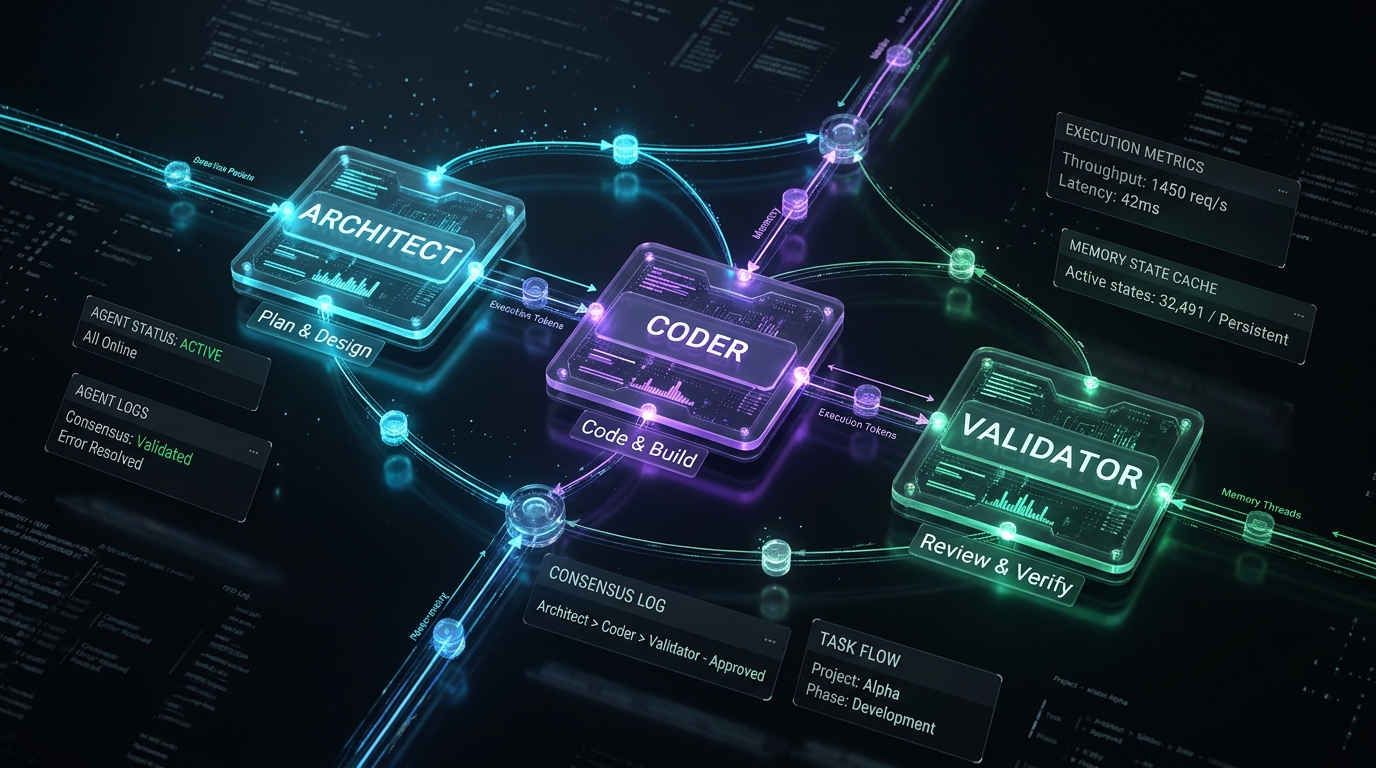 View All
AI AGENTS
Stateful Agent Swarms: How Multi-Agent Coordination Replaced Monolithic Prompts
The shift from single mega-prompts to isolated state machines with scoped tools is redefining production AI engineering.
MC
By Marcus Chen
Editorial Staff • AI Systems Journalist
Published Mar 24, 2026
7 min read
Source: Leansta Engineering IntelligenceOriginal Link
Why This Matters for Independent Builders
Multi-agent frameworks isolate memory and execution steps, achieving commercial-grade reliability.
Engineering teams are abandoning single-pass prompt chains in favor of typed, cyclic graphs where specialized sub-agents independently validate, execute, and cross-examine work.
Over the past twelve months, the primary failure mode of generative AI in business was fragility. When a single prompt was tasked with understanding user intent, querying an API, formatting SQL, and drafting customer communications, hallucination rates climbed steeply.
Today's production standard has crystallized around multi-agent coordination architectures such as LangGraph and CrewAI. By breaking down complex workflows into small, deterministic nodes connected by state transitions, developers can isolate failures, introduce human-in-the-loop verification, and achieve 99.4% execution reliability.
Key Takeaways for Software Builders:
1. Scope Tools Strictly: Give each agent at most 3 tools to maintain determinism.
2. Use Persistent Checkpointing: Never store agent state in ephemeral memory.
3. Implement Guardrail Nodes: Validate intermediate JSON output against strict Pydantic or Zod schemas before passing downstream.
Editorial Policy: Fact-checked by Leansta Signals. Built, not claimed.
Qualified Builders Working in this Domain
Verified talent available for contract execution.
AM
Arjun MehtaEXPERT Builder
Principal AI Agent Architect | LangGraph & Multi-Tenant RAG
CV
Clara VancePROVEN Builder
Enterprise Automation Engineer | n8n & API Orchestration
PS
Priya SharmaPROVEN Builder
Bubble.io & Supabase Systems Architect | Enterprise No-Code